Яндекс.Метрика

Wednesday, May 2, 2018

Speaking of Science: Machines can be creative, too

Speaking of Science
Sarah Kaplan and Ben Guarino on Science
 

(iStock)

Life learned to fly at least four times. First the insects, then pterosaurs (flying reptiles of the Jurassic and Cretaceous), then avian dinosaurs (the ancestors of modern birds) and finally bats.

Yet, intriguingly, every group of animals that has succeeded in taking to the skies does so slightly differently. Birds' feathers work like airfoils, providing lift. The long, webbed wings of bats can curve and stretch to best exploit aerodynamic forces. Insects flap their wings in a flattened figure-eight pattern. And while it would take an extraordinary act of time travel to study the exact physics of pterosaur wings, it's likely that those would surprise us too.

The many, varied solutions to the problem of flight is an example of life's creativity, biologists say. Though evolution happens without foresight, the pressures imposed by natural selection have produced a world of unexpected and delightful results.

But creativity is not the exclusive purview of life. Thanks to neural network expert Janelle Shane, who pointed it out on Twitter, I recently stumbled across this fascinating collection of anecdotes from three dozen computer scientists. They argue that machine learning algorithms — computer programs that figure out how to solve problems through trial and error — can be creative too.

Among their examples:

  • A robot that was supposed to evolve to move as fast as possible didn't develop legs or wheels; it learned to somersault. "Evolution discovers that it is simpler to design tall creatures that fall strategically than it is to uncover active locomotion strategies," the researchers wrote.
  • A computer program designed to automatically fix a buggy sorting algorithm found a simple — if unhelpful — solution to the problem: it short-circuited the buggy program, deleting the contents of the lists it was supposed to sort. If there are no items on a list, it can't be out of order!
  • And algorithm tasked with figuring out how to use the minimum amount of force needed to land a plane reached a solution unexpectedly fast. When researchers took a closer look, they realized that the algorithm was instead applying forces too large for the system to handle, causing it to register as a "zero." As Shane wrote, "The pilot would die but, hey, perfect score."

"Artificial organisms evolving in computational environments have ... elicited surprise and wonder from the researchers studying them," the researchers wrote.

But too often, they say, those bursts of AI brilliance are treated as "obstacles to be overcome, rather than results that warrant study in their own right." And as a result, "many natural scientists do not realize how interesting and lifelike digital organisms are and how natural their evolution can be."

I found this paper captivating, intriguing, and maybe just a little bit disquieting. It's a testament to how easily the tools humans create can turn into something we never imagined. Something interesting to mull over on this Wednesday afternoon.

— Sarah Kaplan

This creature has the oddest eyes in the animal kingdom
The punchy mantis shrimp rolls its eyes up, down, side-to-side and in circles.
 
ADVERTISEMENT
The extraordinary life and death of the world's oldest known spider
This is the story of a 43-year-old spider and the people who knew her.
 
A Yellowstone geyser has experienced unusual eruptions lately — and scientists can't explain why
The geyser activity does not mean that a volcanic eruption is imminent, a scientist says.
 
Stunning scientists, NASA's only moon rover just got canceled
The decision was made even though President Trump has directed the space agency to focus on a return to the moon.
 
ADVERTISEMENT
Scratches on dinosaur teeth reveal their fierce, efficient eating habits
Dinosaur predators used an efficient 'puncture and pull' method to strip meat from their prey.
 
Remains of 140 children unearthed in Peru, the largest child sacrifice in human history
Children appear to have been buried alongside llamas in a sacrifice that likely took place during the 1400s.
 
Fossil footprints 'unique in the world' show a human chasing a giant sloth
Nearly 12,000 years ago, a human literally followed in the footsteps of a giant ground sloth.
 
 
Recommended for you
 
 
Get The Switch newsletter
The day's top stories on the tech industry and tech in our lives.
Sign Up  »
©2018 The Washington Post  |  1301 K St NW, Washington DC 20071

Friday, April 27, 2018

ESO — A New Supernova Over Munich — Organisation Release eso1813

ESO — Reaching New Heights in Astronomy
Subscription preferences | Unsubscribe | View in browser
European
Southern
Observatory
ESO News
27 April 2018

On 26 April 2018, the ESO Supernova Planetarium & Visitor Centre was officially inaugurated, and its doors will be open to the public from tomorrow 28 April 2018. The centre, located at ESO Headquarters in Garching, Germany provides visitors with an immersive experience of astronomy in general, along with ESO-specific scientific results, projects, and technological breakthroughs. All activities in the ESO Supernova will be free of charge during 2018, and shows and other events can be booked online.

The release, images and videos are available on:
https://www.eso.org/public/news/eso1813/

Kind regards,
The ESO Education and Public Outreach Department
27 April 2018


  ESOblog


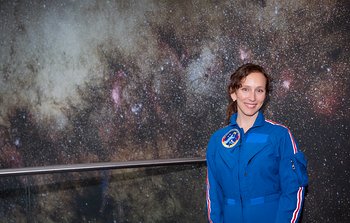
Eyes on the Stars — ESO astronomer Suzanna Randall on what it's like to train as an astronaut

Interview with: Suzanna Randall

27 April 2018: Over the last 40 years, 12 German men have journeyed into space — but no German women. The initiative Astronautin wants to change that. The ambitious programme is currently training ...

Read more

Share this newsletter on:

Like ESO — A New Supernova Over Munich — Organisation Release eso1813 on Facebook   share on Twitter   Google Plus One Button


Receive our News in your preferred language

Start receiving this newsletter in your language


Upcoming Events

Ongoing

28 April 2018: ESO Supernova Planetarium & Visitor Centre opening

24 - 29 June 2019: Starmus V

2 July 2019: Total Solar Eclipse


Upcoming Exhibitions

18 - 23 June 2018: UNISPACE+50. Vienna, Austria.

20 - 31 August 2018: IAU General Assembly. Vienna, Austria.

24 - 29 June 2019: Starmus V event. Bern, Switzerland.

 
Of trails and telescopes  Rainbow skies  Lights over La Silla  An echo of light  La Silla's Great Dane 

You are receiving this newsletter because you subscribed to ESO News.

Subscription preferences | Unsubscribe | View in browser

Follow us on:

Facebook Twitter Vimeo Flickr YouTube LinkedIn Google+ Pinterest Itunes Scribd Issuu Livestream

European Southern Observatory, Karl-Schwarzschild-Str 2, D-85748 Garching bei München, Germany