Яндекс.Метрика

Wednesday, July 11, 2018

Speaking of Science: Think like a scientist

Speaking of Science
Sarah Kaplan and Ben Guarino on Science
 

(iStock)

Hello readers, I'm Carolyn – new to the science team and so happy be here!

I've been covering health care for the past few years, but I'm excited to return to what feels like my roots. I covered science in Boston for years, where I was lucky to be able to spend time with leading researchers studying stem cells, infant cognition or human evolution. Before that, my whole life was shaped by science -- growing up, my polymer chemist dad and molecular biologist mom would lead dinnertime conversations focused on RNA, denatured proteins or the natural gas law. We had a whiteboard prominently placed in the kitchen, for scribbling diagrams and equations. I worked in a molecular biology lab as a teenager, then studied physics in college.

Don't ask me to solve any problem sets today, but even while I've been thinking and writing about topics that have little to do with science, I've never stopped trying to think like a scientist. Science teaches people to be inquisitive, persistent, analytical and logical; to make predictions about how the world works and then test those ideas with experiments. Even when I've been writing about tax reform or drug pricing, I've tried to stick with a scientist's mindset. I even commute to work each day on a bike that has the equation for the Heisenberg Uncertainty Principle anodized onto the top tube.

It's a reminder of the part of physics that always appealed to me most -- the mind-twisting but elegant rules of quantum physics, where reality gets really weird, even if you don't fully understand the math. The Heisenberg Uncertainty Principle says that you can't know the exact position and the speed of an object at the same time. The closer you get to knowing one, the further you get from the other.

--Carolyn

With new genes and an electric shock, scientists turn immune cells against cancer
"It is a game-changer in the field," one cancer researcher said, "and I'm sure that this technology has legs."
 
ADVERTISEMENT
These American salamanders are tougher than climate change — for now
This research shows salamanders are surprisingly able to change their physiology in response to the changing temperature and humidity.
 
California will face a terrible choice: Save cliff-side homes or public beaches from rising seas
Waves have always pounded the California coast. But as seas rise over the remaining century, they will become stronger and more frequent.
 
Every current Supreme Court justice attended Harvard or Yale. That's a problem, say decision-making experts.
Groups of people with similar backgrounds — especially if they're all stars — make worse decisions than diverse groups.
 
ADVERTISEMENT
These tiny monkeys have entered their Stone Age with a bang
For only the fourth time, scientists have observed a new nonhuman primate species using stone tools.
 
'Beautiful' embryos created from near-extinct rhinoceros sperm
Only two northern white rhinos survive, and they are both infertile.
 
 
Recommended for you
 
 
Get The Energy 202 newsletter
Your daily guide to the energy and environment debate.
Sign Up  »
©2018 The Washington Post  |  1301 K St NW, Washington DC 20071

ESO — Colourful Celestial Landscape — Photo Release eso1823

ESO — Reaching New Heights in Astronomy
Subscription preferences | Unsubscribe | View in browser
European
Southern
Observatory
ESO News
11 July 2018

New observations with ESO's Very Large Telescope show the star cluster RCW 38 in all its glory. This image was taken during testing of the HAWK-I camera with the GRAAL adaptive optics system. It shows RCW 38 and its surrounding clouds of brightly glowing gas in exquisite detail, with dark tendrils of dust threading through the bright core of this young gathering of stars.

The release, images and videos are available on:
https://www.eso.org/public/news/eso1823/

Kind regards,
The ESO Education and Public Outreach Department
11 July 2018


  ESO Announcements


Captivating new programme at the ESO Supernova — Exciting new range of planetarium shows and events available from July

11 July 2018: Over the past months, the ESO Supernova team has been preparing an amazing new programme of exciting events and shows for our Planetarium & Visitor centre. We are delighted to ...

Read more


  ESOblog


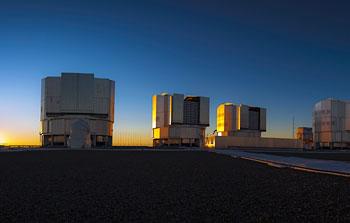
20 Years of Science at Paranal — The past, present and future of the Paranal Observatory

Interview with: Steffen Mieske

6 July 2018: Since the Paranal Observatory opened in May 1998, it has become one of the most productive observatories in the world. The observatory houses the Very Large Telescope (VLT), ESO's premier ...

Read more

Share this newsletter on:

Like ESO — Colourful Celestial Landscape — Photo Release eso1823 on Facebook   share on Twitter   Google Plus One Button


Receive our News in your preferred language

Start receiving this newsletter in your language


 Picture of the Week


9 July 2018
Swimming Moon


New on eso.org


Upcoming Events

Ongoing

24 - 29 June 2019: Starmus V

2 July 2019: Total Solar Eclipse


Upcoming Exhibitions

3 July - 31 August 2018: Exposicion sobre el Extremely Large Telescope (ELT) en Biblioteca de Santiago. Santiago, Chile.

20 - 31 August 2018: IAU General Assembly. Vienna, Austria.

24 - 29 June 2019: Starmus V event. Bern, Switzerland.

 
ALMA spies a new planetary nursery  New SPHERE view of Vesta  A planet hunter and its neighbour  Gentle giants of Chajnantor  Inspired by Interstellar 

You are receiving this newsletter because you subscribed to ESO News.

Subscription preferences | Unsubscribe | View in browser

Follow us on:

Facebook Twitter Vimeo Flickr YouTube LinkedIn Google+ Pinterest Itunes Scribd Issuu Livestream

European Southern Observatory, Karl-Schwarzschild-Str 2, D-85748 Garching bei München, Germany