Яндекс.Метрика

Wednesday, October 3, 2018

Speaking of Science: Here’s to women scientists

Speaking of Science
Talk nerdy to us
 

Donna Strickland, an associate professor at the University of Waterloo, is photographed in her lab after winning the Nobel Prize for Physics. (Peter Power/Reuters)

Yesterday, I had the unexpected pleasure of writing about the announcement that Donna Strickland was among three researchers being awarded this year's Nobel Prize in physics — the first woman to receive the prize in more than a half-century.

The long run of all-male recipients isn't because women haven't been doing prize-worthy science. Exhibit A: Jocelyn Bell Burnell. Exhibit B: Vera Rubin. Exhibit C: Lise Meitner. Exhibit D: Chien-Shiung Wu. I could go on and on and on …

But a host of explicit and implicit biases kept these women's work from being celebrated. Bell Burnell was a graduate student when she built the telescope and analyzed the data that led to the discovery of pulsars — spinning cores of collapsed stars that are among the most important objects in astrophysics — and the work of students is rarely recognized. Meitner was Jewish and had to flee Germany before the publication of her groundbreaking research on nuclear fission; the article ran without her name, and the prize was awarded only to her collaborator. If any justification has been offered for the fact that neither Rubin, whose research proved the existence of dark matter, or Wu, whose work on the Manhattan Project earned her the nickname "the first lady of physics," weren't awarded the field's top prize, I haven't seen it.

Yesterday reminded us how high barriers to women in physics have been — and how much female researchers did to overcome them.

ADVERTISEMENT

Strickland, who helped develop the process that led to the fastest and most powerful lasers ever wielded by humans, traced her research back to Maria Goeppert Mayer, the last woman to win the Nobel Prize in physics. (The only other female laureate is Marie Curie.)

"The work I cite her for started the whole field of multiphoton ionization" (the process of exciting atoms using multiple photons of light) "which is the first thing our laser was used for in my thesis," Strickland told an interviewer from the Royal Swedish Academy of Science, which awards the Nobels.

"But she didn't get to be recognized as scientist, even though she was doing incredible work."

Nepotism rules (not to mention the underlying sexism that assumed that a scientist's wife couldn't also be a scientist) prevented Goeppert Mayer from getting teaching positions at the universities where her husband worked, even though she had a PhD. She spent much of her career as an assistant, a volunteer professor and unpaid contributor. But at Argonne National Lab, where she was a part-time researcher, she helped develop a model of nuclear structures that would eventually win her the Nobel.

ADVERTISEMENT

I thought it was inspiring — and telling — that Strickland used her day of celebration to recognize the research done by her predecessor. Women scientists are often astoundingly supportive of one another, even as they navigate a system that doesn't always support them. When Bell Burnell, the pulsar discoverer, was awarded a $3 million prize for her work last month, she donated it entirely to fund graduate degrees for women, underrepresented minorities and refugees. Vera Rubin, who died in 2016, was celebrated for being a generous mentor and a fierce advocate and activist.

For Strickland and Frances Arnold, who was one of the people awarded the chemistry prize today, for Jocelyn and Vera and Chien-Shiung and Lise and for all the women whose contributions have gone unrecognized — here's to you.

— Sarah

Nobel Prize in chemistry goes to three scientists who harnessed 'the power of evolution'
The scientists created and improved biological molecules with a wide variety of applications, including pharmaceuticals and cleaning supplies.
 
 
Nobel Prize in physics awarded for 'tools made of light'; first woman in 55 years honored
Their studies of the properties of lasers is an example of the ways that scientific discoveries "transform our daily lives," Nobel committee member Olga Botner said.
 
New dwarf planet spotted at the very fringe of our solar system
The new object, nicknamed the Goblin, is very far from the sun.
 
Gambling monkeys may provide clues to why humans take risks
A new study on rhesus monkeys finds that a propensity for risk-seeking might not just be a personality trait, but a function of a specific part of the brain.
 
This major discovery upends long-held theories about the Maya civilization
Archaeologists have uncovered 61,480 structures in Guatemala -- a number the lead author in the study called "humbling."
 
 
Recommended for you
 
 
Get The Intersect newsletter
The latest in digital culture, from viral crazes to exploding memes, delivered every Friday.
Sign Up  »
©2018 The Washington Post  |  1301 K St NW, Washington DC 20071

Monday, October 1, 2018

ESO — A Universe Aglow — Science Release eso1832

ESO — Reaching New Heights in Astronomy
Subscription preferences | Unsubscribe | View in browser
European
Southern
Observatory
ESO News
1 October 2018

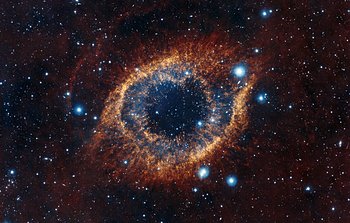
Deep observations made with the MUSE spectrograph on ESO's Very Large Telescope have uncovered vast cosmic reservoirs of atomic hydrogen surrounding distant galaxies. The exquisite sensitivity of MUSE allowed for direct observations of dim clouds of hydrogen glowing with Lyman-alpha emission in the early Universe — revealing that almost the whole night sky is invisibly aglow.

The release, images and videos are available on:
https://www.eso.org/public/news/eso1832/

Kind regards,
The ESO Education and Public Outreach Department
1 October 2018


  ESO Announcements


German Research Foundation selects the ORIGINS Cluster as a new Cluster of Excellence

27 September 2018: Today, on 27 September 2018, the German Research Foundation (Deutsche Forschungsgemeinschaft — DFG) announced the selection of 57 new clusters of excellence, including the cluster ORIGINS — From the origins of the ...

Read more

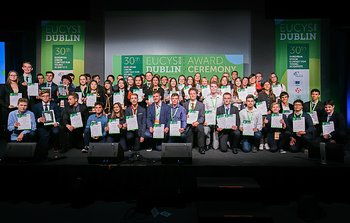
Winners of the 2018 European Union Contest for Young Scientists Announced

27 September 2018: The 2018 winners of the prestigious European Union Contest for Young Scientists (EUCYS) have been announced. Since 1989 the EUCYS has aimed to promote cooperation and interchange between young scientists ...

Read more


  ESOblog


Fellowships at ESO — Hands-on experience at world-class observatories

Xavier Barcons

28 September 2018: Greetings and welcome once more to the ESOblog!

Share this newsletter on:

Like ESO — A Universe Aglow — Science Release eso1832 on Facebook   share on Twitter   Google Plus One Button


Receive our News in your preferred language

Start receiving this newsletter in your language


 Picture of the Week


1 October 2018
Autumn gold


New on eso.org


Upcoming Events

Ongoing

13 October 2018: Open House Day 2018

24 - 29 June 2019: Starmus V

2 July 2019: Total Solar Eclipse


Upcoming Exhibitions

4 - 10 October 2018: Space Week. Dublin and Cork, Ireland.

5 - 6 October 2018: Ciencia Fest 2018. Santiago, Chile.

6 - 14 October 2018: Fête de la Science. Paris, France.

 
Leviathan of the Atacama  An explosive phoenix  Summer Astrocamp 2018  Unrivalled vistas at La Silla  V is for VLT 

You are receiving this newsletter because you subscribed to ESO News.

Subscription preferences | Unsubscribe | View in browser

Follow us on:

Facebook Twitter Vimeo Flickr YouTube LinkedIn Google+ Pinterest Itunes Scribd Issuu Livestream

European Southern Observatory, Karl-Schwarzschild-Str 2, D-85748 Garching bei München, Germany