The big news this week,of course, was the successful landing by NASA's InSight Lander, touching down on Mars on November 26th. Its complicated landing systems deployed with out a hitch, decelerating it from interplanetary velocity to a gentle landing in the Elysium Planitia region of Mars. This spot was chosen because its safe, flat terrain.
The lander will spend a while calibrating itself and taking a few images of its surroundings before using an impact drill to sink a probe 5 meters down into the regolith. Then it will spend the rest of its mission, listening carefully to the interior of Mars, mapping out the internal structure of the Red Planet.
Fraser Cain
Publisher
Universe Today
As always, if you have comments or questions, or suggestions on how I can improve this newsletter, please don't hesitate to reply this email or email me at info@universetoday.com.

Patrons, don't forget to login to Universe Today. That'll remove all the ads for you. Join the 826 Patrons who get our videos early, see behind the scenes, and get no ads on Universe Today.

Thanks to the hardworking Gaia spacecraft, astronomers think they've located a star that formed from the same solar nebula as the Sun. In fact, this star is a virtual twin of the Sun and it's actually pretty close. Well, astronomical speaking.
Subscribe to our podcasts:
Universe Today Guide to Space Video: iTunes - RSS
Universe Today Guide to Space Audio: iTunes - RSS
Astronomy Cast: iTunes - RSS
Weekly Space Hangout: iTunes - RSS

The InSight Lander is huge news, but an even more exciting part of the mission, in my opinion, is the twin cubesats that joined it for the journey. They were launched together with InSight, but then separated and followed it to Mars. The goal was to see if small, relatively inexpensive cubesats could withstand the conditions of interplanetary space travel. Once at Mars, they took images, and relayed data back home from InSight, demonstrating that a cubesat can communicate back to Earth from Mars.

Alan Boyle from Geekwire suggests four books as holiday gift ideas for the space fan in your life. I've got the Space Atlas book and it's amazing, and I really want to check out the Space Stations and All Over the Map. Of course, he also gives a kind word to our new book, The Universe Today Ultimate Guide to the Cosmos.
Want more reviews of our book? Here's a great one from Brian Koberlein.

For the past few months, the mighty Hubble Space Telescope was offline while engineers were troubleshooting a problem with its gyros. These are the spinning wheels that keep the telescope perfectly stable while it's imaging a target for hours, days and even weeks. NASA got the problem resolved, and this was the first image they showcased from the hardworking space telescope. Of course, it's filled with galaxies, classic Hubble.

What's the best way to navigate across the rough surface of another world, like the Moon or Mars? Wheels? Spider legs? What about a rover that could hop like a grasshopper or bunny? The European Space Agency is currently testing a prototype quadruped robot called SpaceBok, which would be able to reach a height of 4 meters jumping in the Moon's low gravity. This would allow it to travel quite quickly in the difficult terrain.

The first stars in the Universe was monsters of pure hydrogen and helium, formed from the primordial elements leftover from the Big Bang. Known as Population III stars, these could have had 100,000 times the mass of the Sun, detonating as enormous supernovae, and seeding the Universe with heavier elements. And astronomers are about to have the instruments and techniques to finally be able to see them.

Blue Origin has been remarkably quiet about the development of their New Glenn orbital rocket. But a newly published Payload User Guide was sent out to potential Blue Origin customers that give plenty of juicy technical details about the new rocket system. It shows the rocket's trajectory, times for booster separation, and recovery of the first stage. If all goes well, we'll see the first launch in 2021.

Before the launch of the new planet-hunting Transiting Exoplanet Survey Satellite (or TESS), astronomers only had rough estimates of how successful it would be. But now the spacecraft is actually finding planets, and a new estimate suggests that the mission will eventually find as many as 14,000 planets around us, including 10 of which that could be an Earthlike world orbiting a Sunlike star in the habitable zone.

I know this video has been making the rounds, but if you haven't seen it already, take a minute and watch it. It's really stunning. You're looking at the launch of the Russian Progress MS-10 cargo spacecraft launched on November 16 from Kazakhstan to send cargo to the International Space Station. Astronaut Alexander Gerst captured the launch from orbit on board the station. Wow.

As climate change continues to impact our planet's weather, contributing to sea level rise, increased wildfires and hurricane damage, scientists have been considering ways to deal with the increased temperatures. One idea would be to spray particles into the atmosphere like an artificial volcano eruption. And it turns out, it's surprisingly inexpensive and feasible to do. For a few billion dollars a year, we could offset trillions of dollars in damage. Of course, there are sure to be unintended consequences. Should we?

I really like this recently released picture from NASA's Mars Reconnaissance Orbiter. It's an image taken in the polar regions of Mars, where the last remnants of carbon dioxide frost clings to the ground before it warms up to the point that that it sublimates into the atmosphere. The frost shows the strangely shaped cracks in the ground around a large impact crater.

We lost our chance to study the interstellar asteroid/comet Oumuamua and now it's speeding back out of the Solar System. But good news, the Solar System has probably captured hundreds of interstellar objects just like it. Now we just have to identify them and send missions to study them.

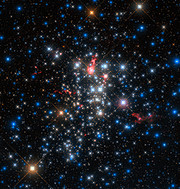
This ancient globular star cluster (NGC 1866) has stars which are almost as old as the Universe itself. But it also has stars which formed relatively recently, which makes it look both young and old. It's believed that NGC 1866 formed early on, but then passed through a dust cloud, allowing it to capture new star making material to begin a second round of star formation.

You've probably never heard of the Andromedids Meteor Shower, and normally, they're not that exciting to watch. But in the past there have been full on storms with as many as 15,000 meteors per hour in the past. Because of our path through the trail of the comet that feeds the shower, we could be in for a treat when they peak on December 3rd, so make sure you keep an eye to the sky.
Other Interesting Space Stuff

This isn't a photograph of Mars, it's a painting created by @stefanobove_art. Normally I feature astrophotography on our Instagram account, but I also like to feature artwork inspired by space too.
We have featured nearly 1,000 astrophotographers on our Instagram page, which has more than 144,000 followers. Want to do a takeover? Use the hashtag #universetoday and I'll check out your photos.

Find your way across the night sky. Choose a variety of astronomy gear. Follow the Moon and the planets. Find deep sky objects across the seasons in both hemispheres. Observe comets, asteroids, satellites and space stations. Learn to do astrophotography.
Get it on Amazon for only $18.89. Here are some other options.
| | | | |