Яндекс.Метрика

Monday, February 5, 2018

ESO — TRAPPIST-1 Planets Probably Rich in Water — Science Release eso1805

ESO — Reaching New Heights in Astronomy
Subscription preferences | Unsubscribe | View in browser
European
Southern
Observatory
ESO News
5 February 2018

A new study has found that the seven planets orbiting the nearby ultra-cool dwarf star TRAPPIST-1 are all made mostly of rock, and some could potentially hold more water than Earth. The planets' densities, now known much more precisely than before, suggest that some of them could have up to 5 percent of their mass in the form of water — about 250 times more than Earth's oceans. The hotter planets closest to their parent star are likely to have dense steamy atmospheres and the more distant ones probably have icy surfaces. In terms of size, density and the amount of radiation it receives from its star, the fourth planet out is the most similar to Earth. It seems to be the rockiest planet of the seven, and has the potential to host liquid water.

The release, images and videos are available on:
https://www.eso.org/public/news/eso1805/

Kind regards,
The ESO Education and Public Outreach Department
5 February 2018


  ESO Announcements


ESO at the Big Science Business Forum 2018

2 February 2018: Big Science is a term that encapsulates the way in which scientific progress increasingly relies on large-scale projects, often funded by national governments or groups of governments, leading to increasingly ...

Read more

ESOcast 149: Fast Track Your Career With the ESO Studentship Programme

2 February 2018: ESO's Studentship programme provides a valuable opportunity for astronomers of the future to gain experience at the most productive ground-based astronomical observatory in the world. PhD students work alongside ...

Read more

AstroCamera 2018 Competition Open for Entries

1 February 2018: ESO invites you to take part in AstroCamera 2018 — an international competition in support of popularising astronomy and astrophotography. The competition is organised by the Hewelianum Centre in Gdańsk, Poland ...

Read more


  ESOblog


Little Galaxies, Big Mysteries — Federico Lelli on what dwarf galaxies tell us about the cosmological model

Interview with: Federico Lelli

2 February 2018: In order to understand some of the weirdest and most wonderful phenomena in the Universe, scientists rely on the Lambda Cold Dark Matter (LCDM) model. This model assumes the existence ...

Read more

Share this newsletter on:

Like ESO — TRAPPIST-1 Planets Probably Rich in Water — Science Release eso1805 on Facebook   share on Twitter   Google Plus One Button


Receive our News in your preferred language

Start receiving this newsletter in your language


 Picture of the Week


5 February 2018
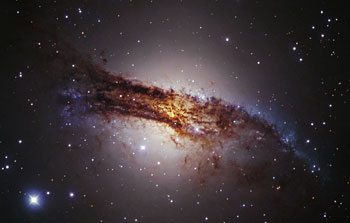
Mapping a Merger


New on eso.org


Upcoming Events

Ongoing

26 April 2018: Girls' Day at ESO Headquarters

28 April 2018: ESO Supernova Planetarium & Visitor Centre opening

2 July 2019: Total Solar Eclipse


Upcoming Exhibitions

26 - 28 February 2018: Big Science Business Forum. Copenhagen, Denmark.

3 - 6 April 2018: EWASS. Liverpool, United Kingdom.

20 - 31 August 2018: IAU General Assembly. Vienna, Austria.

 
A diamond in the rough  Desert vistas  Seeing stars in a mountain environment  Supermoon beckons in the new year  Ribbons and pearls 

You are receiving this newsletter because you subscribed to ESO News.

Subscription preferences | Unsubscribe | View in browser
Follow us on:

Facebook Twitter Vimeo Flickr YouTube LinkedIn Google+ Pinterest Itunes Scribd Issuu Livestream

European Southern Observatory, Karl-Schwarzschild-Str 2, D-85748 Garching bei München, Germany


Wednesday, January 31, 2018

ESO — Glory From Gloom — Photo Release eso1804

ESO — Reaching New Heights in Astronomy
Subscription preferences | Unsubscribe | View in browser
European
Southern
Observatory
ESO News
31 January 2018

A dark cloud of cosmic dust snakes across this spectacular wide field image, illuminated by the brilliant light of new stars. This dense cloud is a star-forming region called Lupus 3, where dazzlingly hot stars are born from collapsing masses of gas and dust. This image was created from images taken using the VLT Survey Telescope and the MPG/ESO 2.2-metre telescope and is the most detailed image taken so far of this region.

The release, images and videos are available on:
https://www.eso.org/public/news/eso1804/

Kind regards,
The ESO Education and Public Outreach Department
31 January 2018


  ESO Announcements


Sharper Images for VLT Infrared Camera — Adaptive optics facility extended to HAWK-I instrument

30 January 2018: ESO's Very Large Telescope (VLT) now has a second instrument working with the powerful Adaptive Optics Facility (AOF). The infrared instrument HAWK-I (High Acuity Wide-field K-band Imager) [1] is ...

Read more

5th Photo NightScape Awards Open for Entries

29 January 2018: ESO is inviting submissions for the fifth Photo Nightscape Awards (PNA) —  an international competition for astrophotographers. As a partner in the competition, which is organised by the Chasseurs de Nuits ...

Read more


  ESOblog


Protecting the Earth from Cosmic Clashes — ESO's role in the International Asteroid Warning Network

Interview with: Olivier Hainaut

Interview with: Andy Williams

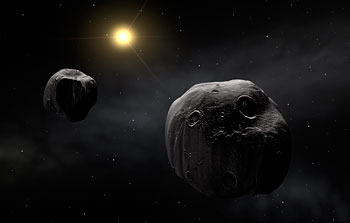
26 January 2018: 65 million years ago, the most famous asteroid in history slammed into Earth and most likely exterminated the dinosaurs. Disconcertingly, we are no less likely to be to hit by ...

Read more

Share this newsletter on:

Like ESO — Glory From Gloom — Photo Release eso1804 on Facebook   share on Twitter   Google Plus One Button


Receive our News in your preferred language

Start receiving this newsletter in your language


 Picture of the Week


29 January 2018
A diamond in the rough


Upcoming Events

Ongoing

26 April 2018: Girls' Day at ESO Headquarters

28 April 2018: ESO Supernova Planetarium & Visitor Centre opening

2 July 2019: Total Solar Eclipse


Upcoming Exhibitions

26 - 28 February 2018: Big Science Business Forum. Copenhagen, Denmark.

3 - 6 April 2018: EWASS. Liverpool, United Kingdom.

20 - 31 August 2018: IAU General Assembly. Vienna, Austria.

 
Desert vistas  Seeing stars in a mountain environment  Supermoon beckons in the new year  Ribbons and pearls  Comparison image: HAWK-I and Hubble Explore a Cluster with the Mass of two Quadrillion Suns 

You are receiving this newsletter because you subscribed to ESO News.

Subscription preferences | Unsubscribe | View in browser

Follow us on:

Facebook Twitter Vimeo Flickr YouTube LinkedIn Google+ Pinterest Itunes Scribd Issuu Livestream

European Southern Observatory, Karl-Schwarzschild-Str 2, D-85748 Garching bei München, Germany