Яндекс.Метрика

Thursday, July 26, 2018

ESO — First Successful Test of Einstein’s General Relativity Near Supermassive Black Hole — Science Release eso1825

ESO — Reaching New Heights in Astronomy
Subscription preferences | Unsubscribe | View in browser
European
Southern
Observatory
ESO News
26 July 2018

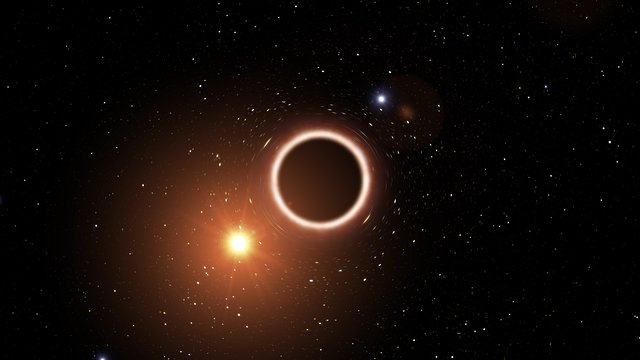
Observations made with ESO's Very Large Telescope have for the first time revealed the effects predicted by Einstein's general relativity on the motion of a star passing through the extreme gravitational field near the supermassive black hole in the centre of the Milky Way. This long-sought result represents the climax of a 26-year-long observation campaign using ESO's telescopes in Chile.

The release, images and videos are available on:
https://www.eso.org/public/news/eso1825/

Kind regards,
The ESO Education and Public Outreach Department
26 July 2018


  ESO Announcements


ESOcast 173: First Successful Test of Einstein's General Relativity Near Supermassive Black Hole

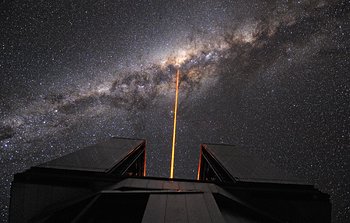
26 July 2018: An epic 26 year campaign observing the Black Hole at the centre of the Milky Way Galaxy has yielded some remarkable results. An international team of astronomers used the cutting-edge ...

Read more

Live Broadcast from ESO Announcing News from the Heart of the Milky Way

24 July 2018: ESO will hold a press conference on 26 July 2018 at its Headquarters in Garching, Germany, to present unique observations of the centre of the Milky Way and their significance ...

Read more

Media Advisory: Press Conference at ESO HQ Announcing News from the Heart of the Milky Way

19 July 2018: ESO will hold a press conference on 26 July 2018 at 14:00 CEST, at its Headquarters in Garching, Germany, to present unique observations of the centre of the Milky ...

Read more

Share this newsletter on:

Like ESO — First Successful Test of Einstein's General Relativity Near Supermassive Black Hole — Science Release eso1825 on Facebook   share on Twitter   Google Plus One Button


Receive our News in your preferred language

Start receiving this newsletter in your language


 Picture of the Week


Upcoming Events

Ongoing

24 - 29 June 2019: Starmus V

2 July 2019: Total Solar Eclipse


Upcoming Exhibitions

3 July - 31 August 2018: Exposicion sobre el Extremely Large Telescope (ELT) en Biblioteca de Santiago. Santiago, Chile.

20 - 31 August 2018: IAU General Assembly. Vienna, Austria.

24 - 29 June 2019: Starmus V event. Bern, Switzerland.

 
The colours of Antu  Swimming Moon  ALMA spies a new planetary nursery  New SPHERE view of Vesta  A planet hunter and its neighbour 

You are receiving this newsletter because you subscribed to ESO News.

Subscription preferences | Unsubscribe | View in browser

Follow us on:

Facebook Twitter Vimeo Flickr YouTube LinkedIn Google+ Pinterest Itunes Scribd Issuu Livestream

European Southern Observatory, Karl-Schwarzschild-Str 2, D-85748 Garching bei München, Germany


Wednesday, July 25, 2018

Speaking of Science: Shark Week

Speaking of Science
Talk nerdy to us
 

It's Shark Week! And confession time. I love sharks. But I hate Shark Week. Every year, Shark Week feels like the latest disappointment in adrenaline junkied PR for an animal that, frankly, doesn't need any more bad press. As a coral reef scientist, I've spent a lot of time with both sharks and shark scientists. The latter are usually a more rambunctious bunch.

An adult Squalus clarkae found in the waters off Belize. (MarAlliance)

Earlier this month, a new species of shark was named after the late shark scientist Eugenie Clark. Clark was a charismatic and pioneering scientist of the 20th century. I wonder what she would think of our modern, flashy Shark Week. She's quoted as saying that the " 'gangsters of the deep' had gotten a bad rap."

[You can also follow Genie The Shark on twitter, named after Eugenie]

"They've got big teeth, but then so does your dog," Clark said in her thick New York accent, in a Mote Marine Lab video

Clark was born in the '20s to an American father and Japanese mother. She started her work as a scientist at a time when women were actively discouraged in the field, and tensions with Japanese Americans post World War II were high. While typing school and secretarial positions were common postgrad career plans for young women in the 1940s, Clark said: "No, I don't want to be anybody's secretary. I want to do that stuff myself." She set out to get a PhD in marine biology.

Eugenie Clark in the field as a young woman. (Mote Marine Laboratory)

ADVERTISEMENT

Turned away from Columbia University because as a woman she might leave early to start a family, Clark attended New York University. Her scientific accomplishments are many. When she stumbled upon sharks sleeping on the ocean floor in Mexico, she dispelled the myth that all sharks must keep swimming to stay alive. She found a fish from the Red Sea called the Moses sole that secretes a natural shark repellent. She also created the first fish test tube baby.

During my time as a coral scientist, we discovered a large population of whale sharks. They kept swimming over my sites, where I was monitoring Frisbee-shaped corals. Since we were short on staff, the shark researchers had to train me to wield a spear gun and assist with their tagging operation. Gripping a sling shot spear as tall as me and waiting for the captain to call out "shark!" was the most thrilling thing I've ever done.

It was a glimpse into the incredibly exciting world of shark science. One that certainly doesn't need to be pumped up with fake shark attacks and scary music.

A 12-mile-wide body of water lies beneath a Mars ice cap
A cold, salty body of water beneath the Martian south pole is a possible "habitat."
 
Thousands of scientists object to Trump's border wall
A border wall threatens plant and animal species and scientific research, a new report says.
 
ADVERTISEMENT
Why do people believe the moon landing hoax or other conspiracy theories?
It's hard to reason with people who embrace conspiracy theories, but some strategies are more effective than others.
 
Rare asteroid duo dances in the stars
Two equally matched asteroids are circling each other as they circle the sun.
 
Neanderthals could start fires with their stone tools, new study suggests
The relationship between Neanderthals and fire is "kind of a hot topic," archaeologists say
 
 
Recommended for you
 
 
Get The Energy 202 newsletter
Your daily guide to the energy and environment debate.
Sign Up  »
©2018 The Washington Post  |  1301 K St NW, Washington DC 20071