Яндекс.Метрика

Wednesday, September 26, 2018

ESO — Ireland to Join the European Southern Observatory — Organisation Release eso1831

ESO — Reaching New Heights in Astronomy
Subscription preferences | Unsubscribe | View in browser
European
Southern
Observatory
ESO News
26 September 2018

On 26 September, John Halligan T.D., Irish Minister of State for Training, Skills, Innovation, Research and Development and Xavier Barcons, Director General of ESO signed the Accession Agreement that will lead to Ireland joining the European Southern Observatory (ESO) — the world's most productive astronomical observatory. ESO is looking forward to welcoming Ireland and will work with the nation's astronomers and industry to advance the cutting edge of astronomy.

The release, images and videos are available on:
https://www.eso.org/public/news/eso1831/

Kind regards,
The ESO Education and Public Outreach Department
26 September 2018


  ESO Announcements


ESO's VLT Adaptive Optics Facility receives the 2018 Paul F. Forman Team Engineering Excellence Award

18 September 2018: The pioneering work of ESO's Adaptive Optics Facility (AOF) team has been recognised by the Optical Society (OSA). The AOF team have been awarded the 2018 Paul F. Forman ...

Read more

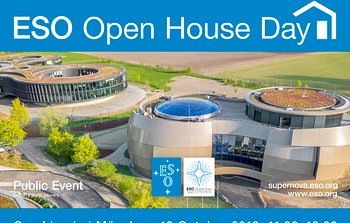
ESO Open House Day 2018

13 September 2018: On Saturday 13 October 2018 between 11:00 and 18:00 CEST, the European Southern Observatory (ESO) will open its doors to the public at its headquarters in Garching bei ...

Read more


  ESOblog


The Rise of Astrotourism in Chile — And the importance of preserving the magnificent dark skies over ESO's telescopes

Nicole Shearer

21 September 2018: For the ultimate stargazing experience, Chile is an unmissable destination. The skies above the Atacama Desert are clear for about 300 nights per year, so this high, dry and dark ...

Read more

Share this newsletter on:

Like ESO — Ireland to Join the European Southern Observatory — Organisation Release eso1831 on Facebook   share on Twitter   Google Plus One Button


Receive our News in your preferred language

Start receiving this newsletter in your language


 Pictures of the Week


24 September 2018
Leviathan of the Atacama


17 September 2018
An explosive phoenix


Upcoming Events

Ongoing

24 - 29 June 2019: Starmus V

2 July 2019: Total Solar Eclipse


Upcoming Exhibitions

28 September 2018: European Researchers' Night SHARPER. Naples and Caserta, Italy.

4 - 10 October 2018: Space Week. Dublin and Cork, Ireland.

5 - 6 October 2018: Ciencia Fest 2018. Santiago, Chile.

 
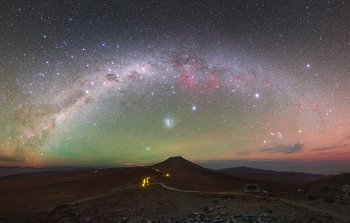
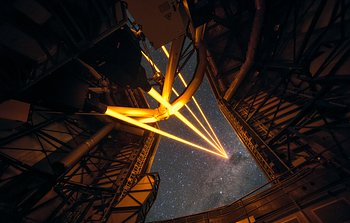
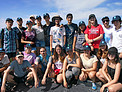
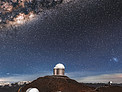
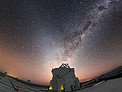
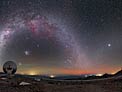
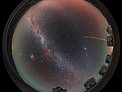
Summer Astrocamp 2018  Unrivalled vistas at La Silla  V is for VLT  Under the celestial arch  A fulldome family portrait 

You are receiving this newsletter because you subscribed to ESO News.

Subscription preferences | Unsubscribe | View in browser
Follow us on:

Facebook Twitter Vimeo Flickr YouTube LinkedIn Google+ Pinterest Itunes Scribd Issuu Livestream

European Southern Observatory, Karl-Schwarzschild-Str 2, D-85748 Garching bei München, Germany


Wednesday, September 19, 2018

Speaking of Science: Physics al dente

Speaking of Science
Talk nerdy to us
 

Examples of "nuclear pasta," the material deep within neutron stars that was calculated to be the toughest material in the universe.

Speaking of Science readers will recall that in October, astrophysicists and astronomers reported the observation of a kilonova — the catastrophic merger of two neutron stars into one object. (This object might be a black hole, but there is no consensus.) A neutron star is born when a mid-sized star (about four to eight times bigger than the sun) goes supernova. Its pieces collapse inward. Its core is so dense and compact that a billion tons of neutron star fits in a teaspoon.

Researchers at Canada's McGill University, as well as the California Institute of Technology and Indiana University, crunched the numbers on neutron star material. It turns out that a dense soup of neutron clusters in the stars' crust may be the toughest stuff in the universe, the scientists calculate in a new study.

Those clusters are what astrophysicists call "nuclear pasta," structures made of subatomic particles that could only exist at densities found in the crust of a neutron star. Those densities force the protons and neutrons into flat sheets, clumps and other shapes that resemble, if you squint, pasta. To smash this pasta takes a force, Livescience reported, 10 billion times greater than what can shatter steel.

ADVERTISEMENT

There's still a lot these researchers don't know about nuclear pasta. "How large a mountain can you build on a neutron star before the crust breaks and it collapses? What will it look like?" McGill University postdoctoral researcher and study author Matt Caplan asked in a statement. "And, most importantly, how can astronomers observe it?"

— Ben

Controversy over sexual misconduct case roils Yale University
The case is a window into the aftermath of sexual misconduct cases, and the growing questions that institutions face about how to hold their most powerful accountable.
 
Scientists identify four personality types
A psychologist's first reaction to his own study was: "This is nonsense." But the data convinced him.
 
ADVERTISEMENT
Archaeologists just found the oldest drawing. It's a 70,000-year-old hashtag.
The crosshatch pattern was drawn using a red rock as soft as lipstick with a skinny point.
 
Scientists discover three new sea creatures in depths of the Pacific Ocean
The new species were discovered in the Atacama Trench and are "highly adept at living where few other organisms can."
 
Toxic red tide algae moves north near Tampa Bay, killing hundreds of thousands of fish
The summer is over, but the toxic algae bloom has drifted into new areas of Florida, officials have warned.
 
 
Recommended for you
 
 
Get the Energy and Environment newsletter
The latest news about climate change, energy and the environment, delivered every Thursday.
Sign Up  »
©2018 The Washington Post  |  1301 K St NW, Washington DC 20071